
Interacting Layers Affecting Student Achievement

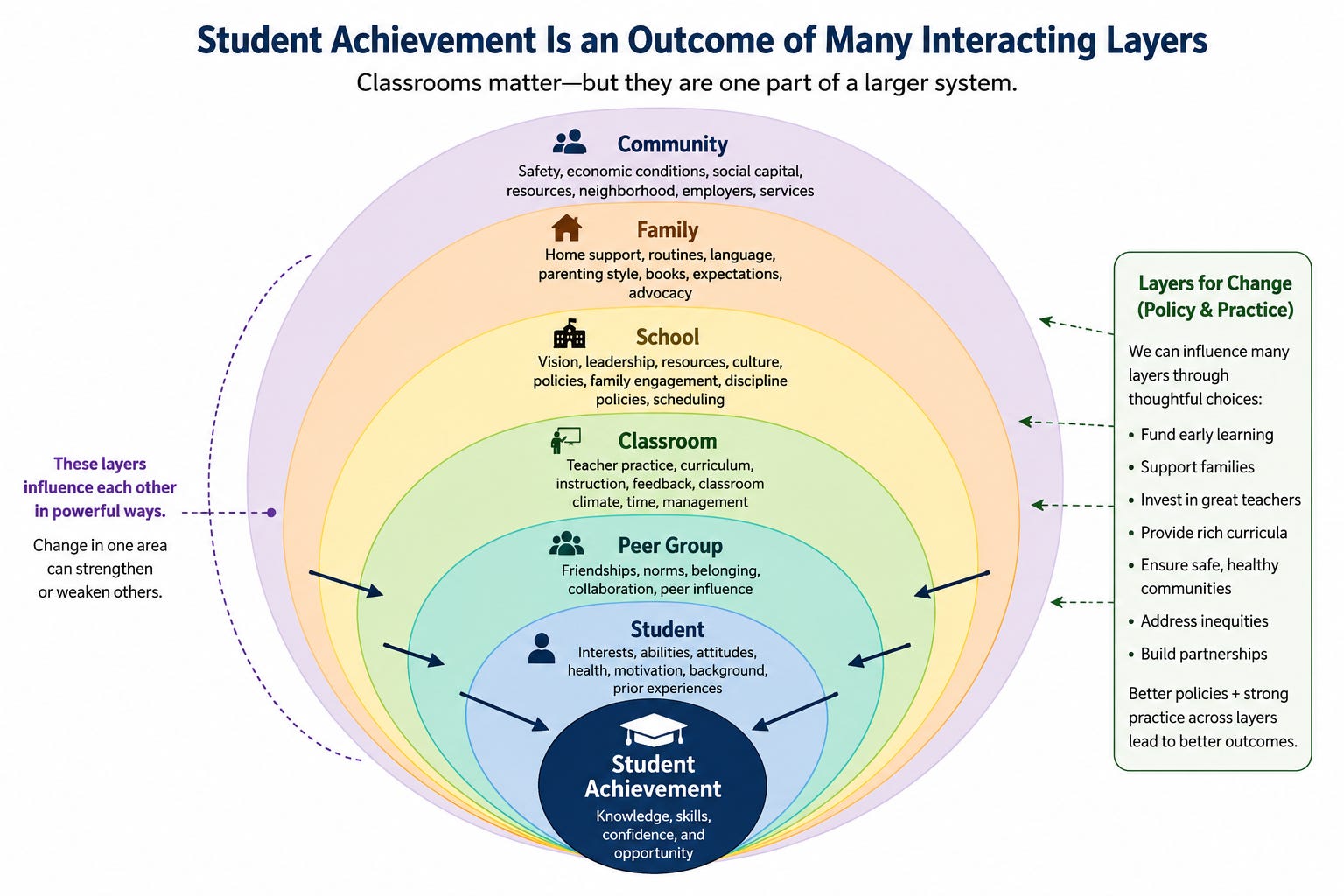
Student results are often treated like a verdict on schools. If results look strong, schools are praised; if they look weak, schools are blamed. That story is simple . . . and misleading because it ignores most of what influences how well students do. Learning is not the product of a single classroom, or even a single school. It is the outcome of many interacting layers that surround each student.
The diagram above shows those layers as nested. At the base is student achievement, the knowledge and confidence students acquire. Just outside that are students, each of whom brings their interests, abilities, attitudes, health, motivation, background, and prior learning to every lesson. Around them is the peer group, where friendships, norms, a sense of belonging, collaboration, and the peer influences that help shape whether it feels normal to try hard, ask questions, and aim high.
The next layer is the classroom, where day‑to‑day teaching happens. Teacher practice, curriculum, instruction, feedback, classroom climate, and time management all play a direct role in what students learn. Classrooms are located within schools that provide vision and leadership, distribute resources, build culture, set policies, engage families, schedule events, and administer discipline. Strong schools create conditions where effective classrooms are more likely to flourish and to be sustained over time.
Beyond the school are influences that are educationally significant, even though they are not formally part of the education system. Families shape home support, routines, language use, parenting style, books and learning materials, expectations, and advocacy for their children. Families live in communities that differ in safety, economic conditions, social capital, available resources, neighbourhood characteristics, employers, and services. Changes in any of these layers can strengthen or weaken the others.
The key point is that many of these influences are amenable to change through policy and practice. We can fund early learning, support families, invest in great teachers, and provide rich curricula. We can work to ensure safe, healthy communities, address inequities, and build partnerships across sectors. When better policies are combined with strong practice across multiple layers, students are more likely to experience better outcomes. Instead of asking, “What are schools doing wrong?”, a more realistic and hopeful question is “How can communities, families, schools, and classrooms each use the levers they control to support student achievement?”